How to choose the right flow sensor in 9 steps

- Do you want to measure a liquid or gaseous medium?
- Which medium?
- Flow/throughput measuring range
- Temperature measuring range
- Pressure range
- External influences (air bubbles, rapid temperature changes, viscosity changes)
- Inline or immersion sensor and pipe size
- With or without display?
- Local reading or remote monitoring
Step 1: Liquid or gaseous?
Only the AS001 and AS005 flow sensors are suitable for measuring gaseous media. They can also be used for liquids. The other flow and flow-rate sensors can only be used with liquids.
Step 2: Which medium?
To select the right flow sensor, you must consider the medium in which the sensor is to measure. Get an initial overview of our flow sensors and flow meters in this table.
| Item | Emulsion (oil, water) | Glycol | Cooling water | Deionised water | Contaminated water | Chemicals | Oil |
|---|---|---|---|---|---|---|---|
| AS001/ AS005 | yes | yes | yes | yes | yes | yes | yes |
| AS002-AS004 | yes | yes | yes | no | yes | yes | no |
| AS006-AS011 | yes* | yes* | yes | yes | yes | yes* | no |
* When using our vortex sensors, correction factors may need to be taken into account for the media marked. Further information can be found in the relevant operating instructions.
The sensor materials that come into contact with the medium must be checked for chemical resistance to the medium. You can find the materials that touch the medium on the product page in the technical data.
Step 3: Flow / flow-rate measuring range
Step 4: Temperature measuring range
Step 5: Pressure range
Step 6: Other external influences
| Item | Air bubbles | rapid temperature changes | Viscosity changes | Vibrations |
|---|---|---|---|---|
| AS001/ AS005 | possible | problematic | possible | well suited |
| AS002-AS004 | possible | well suited | well suited | well suited |
| AS006-AS011 | possible | well suited | problematic | problematic |
Step 7: Inline or immersion sensor and pipe size
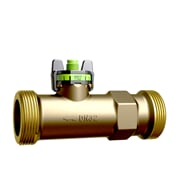
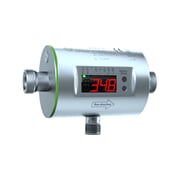
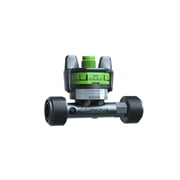
AS002-AS004 and AS006-AS011 are inline flow-rate sensors. With inline flow sensors, the measuring section is integrated into the sensor. The sensor is installed in the system between two pipelines. This brings the following advantages:
- Installation is simplified compared with immersion flow sensors
- Fewer requirements for inlet and outlet runs before and after the sensor (see section Installation conditions)
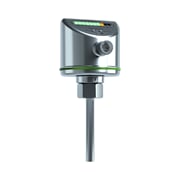
AS001 and AS005 are immersion flow sensors. Immersion sensors are inserted laterally into a pipe using a T-piece or a weld-in adapter. It should be noted that the measuring point has a uniform laminar flow; therefore, more installation conditions must be observed. This has the following advantages:
- Existing systems can be retrofitted more easily.
- The same sensor can be used in pipes with different diameters.
Step 8: With or without display?
Step 9: Local reading or remote monitoring
Local reading is quick and easy on the display. If the sensor’s measured values are to be monitored remotely, this is easy with our IoT gateway io-key IO001. Any IO-Link-capable sensor can simply be connected to the gateway and the measured values are transmitted immediately via NB-IoT to the cloud and displayed on an individual dashboard. You can also set up alarm notifications that are sent by SMS directly to your mobile phone, so you are always up to date and can react quickly if problems occur. Suitable sensors in conjunction with the io-key: AS002-AS005.

 Cloud compatible