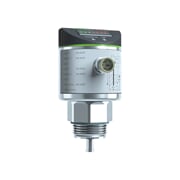
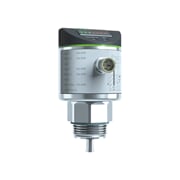
Probe rod or probe rod with coaxial tube for guided microwave level sensors?
Level sensors with guided microwave emit a microwave signal that is reflected at the surface of the medium; the distance is calculated by measuring the signal’s transit time. This measuring principle requires a probe rod that guides the microwave emitted by the sensor to the surface of the medium. Whether a probe rod / single-rod probe or a probe rod together with a coaxial tube is required depends on the dielectric constant (DK value) of the medium whose level is to be monitored.
Probe rod / single-rod probe only: for media with a dielectric constant >20, conductive media
Probe rod / single-rod probe + coaxial tube: media with a dielectric constant >2 and <20 (e.g. oils and oil-based media), poorly conductive media
Guided microwave with single-rod probe
The single-rod probe consists of a single probe rod. Operation with a single-rod probe is suitable for detecting aqueous media with a dielectric constant > 20.
What do you need to consider when using a single-rod probe?
For correct operation with single-rod probes, the device requires a sufficiently large metal coupling plate. This is a prerequisite for coupling the microwave pulse into the tank with optimum transmit power. The flange plates available as accessories are not sufficient as a coupling plate. When installed in closed metal tanks, the tank lid serves as the coupling plate. When installed in open metal tanks, plastic tanks, or metal tanks with plastic lids, a sufficiently large holding plate, metallic support or similar must be used. Using the coaxial tube is also an option. When operating with a single-rod probe, minimum distances to tank walls, objects in the tank, the tank bottom and other level sensors must be observed.
Guided microwave with single-rod probe and coaxial tube
The coaxial tube is slid over the probe rod and screwed to the sensor. The probe rod is centred in the coaxial tube by one or more spacers. When operating with a coaxial probe, in addition to aqueous media and heavily soiled or adhering aqueous media, media with a low dielectric constant (e.g. oil and oil-based media) can also be measured. The combination of probe rod and coaxial tube is suitable for media with a dielectric constant > 2 / < 20
What should you consider when using a coaxial tube?
When operating with a coaxial probe, no coupling plate is required. In addition, no minimum distances to tank walls and objects inside the tank are required.

Using a metal saw, both the coaxial tube and the single-rod probe can easily be shortened to the required length (minimum length 100 mm). For more details, see the operating instructions for the coaxial tube or single-rod probe.
Thorsten Takacs, Account Manager


What is the dielectric constant (DK value)?
Dielectricity (permittivity) is a physical property that indicates how easily a material allows an electric field to pass through it. It measures a material’s ability to store electric charge and influence an electric field. Materials with high dielectricity can polarise and store electric fields more effectively, meaning they can absorb or release electrical energy more efficiently. The higher the dielectric constant (DK value), the more conductive a medium is.

 Cloud compatible