


19 in stock!
Online -5,5 %
315.83 €
298.46 €

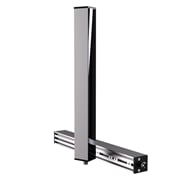
Light curtains detect objects by evaluating the interruption of multiple parallel light beams. This allows them to precisely and contactlessly detect even small or irregularly shaped objects. They are ideal for counting and positioning tasks, as well as for monitoring passages or conveyor lines at high speed.
All items of the category Light Curtains:
 Cloud compatible
 Cloud compatible
 Cloud compatible


A light curtain is an optical sensor that, either consisting of a transmitter and a receiver or used together with a reflector, creates a curtain of parallel light beams (usually infrared). If one of these beams is interrupted by an object, the sensor converts this into a switching signal. This technology is used in automation for reliable area monitoring, for example for object detection and presence monitoring on conveyor belts in logistics and manufacturing.
Choosing the right light curtain is crucial for the successful implementation of your applications. Here are four steps to help you find the right model:
Do you need a high switching frequency for fast processes or maximum robustness for harsh environments?
For small objects & highest precision: The AO501–AO503 series reliably detects objects with a diameter from 3 mm at a switching distance of 0.2–4.5 m and a detection height of 69 to 309 mm.
For larger objects & maximum robustness: The AO504–AO506 series is designed for reliable detection in harsh industrial environments, e.g. of packages, with a switching distance of 200–1000 mm and a monitoring height of up to 450 mm.
Choose IO-Link (AO501–503 series) if you need flexible adjustments (timers, counters), centralized status monitoring, or NO/NC functions.
Choose the standard variant (AO504–506 series) for simple "plug-and-play" solutions with a basic closing contact output and adjustment via potentiometer.
In dusty or humid environments, light curtains with protection class IP67 are necessary to prevent the ingress of water and dust.
Choosing the right light type optimizes performance and simplifies installation. Here is our technicians' decision guide:
| Feature | Visible red light | Invisible infrared light |
|---|---|---|
| Biggest advantage | Fastest commissioning: The visible light spot enables alignment within seconds without aids. | Maximum robustness: The higher power reliably penetrates dust, dirt, and vapor. Insensitive to ambient light. |
| Ideal for | Standard applications in clean environments and quick visual functional checks. | Demanding environments (wood, paper, heavy industry) |
| Discover now | Our visible red light models | Our infrared models |
The problem: In conveyor technology, it must be reliably detected whether an object is located in a specific area of the conveyor belt. Point sensors are not always sufficient when larger areas need to be monitored. This can lead to faulty processes or unnecessary downtimes.
Solution with autosen light curtains: A light curtain monitors the defined area with multiple closely spaced light beams. As soon as conveyed goods enter the detection area, this is detected immediately. This makes the light curtain ideal for contactless area monitoring on the conveyor belt.
The result: Object detection on the conveyor belt becomes significantly more reliable. Processes can be controlled more safely and material jams detected earlier. This increases process reliability and supports smooth material flow.
Pay attention to the protection rating (e.g. IP67), the switching distance (range), the required resolution (smallest detectable object diameter), and the switching frequency.
A light curtain monitors an area. It creates a "light curtain" and detects an object at any position within this curtain. Ideal for area monitoring or counting tasks.
Other sensors, such as reflective photoelectric sensors, only monitor a single point. They detect whether an object has reached one specific, exactly defined position. If you want to learn more about optical sensors, you can find more information on the overview page Optical sensors.
This refers to reflective light curtains. Unlike one-way systems with separate transmitter and receiver, all electronics are integrated into a single unit here. Only a reflector is required on the opposite side. This significantly reduces installation effort and lowers costs. In addition, this design offers advantages in confined spaces, as no separate receiver has to be mounted. In such applications a reflector can usually be integrated more easily and flexibly than a separate transmitter–receiver solution.
With IO-Link you can not only make settings (teach-in), but also monitor the status of each individual light beam in real time. In addition, timer functions, counters and logic links (AND/OR) can be configured directly in the sensor. This enables predictive maintenance and flexible adjustments.

 Free delivery to selected countries