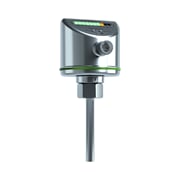
Cloud compatible
 36 in stock!
Online -5,5 %
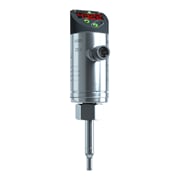
258.86 €
244.62 €

Thermal flow meters operate according to the thermal principle. A probe with a temperature sensor and a heated reference sensor is inserted into the pipe so it is in contact with the medium. They are used with liquid and gaseous media (high purity, free of particles and solids), for example to monitor agitators and cooling circuits, to protect against dry running, or to monitor flow in pipes. Read more here
All items of the category Thermal flow meters:
Cloud compatibleCalorimetric flow sensors (also known as calorimetric flow meters or thermal flow meters) are used to monitor the flow of liquids and gases in industrial automation. The thermal measuring principle uses a temperature difference: an integrated heating element warms the measuring tip, while precise temperature sensors detect the cooling caused by the medium flowing past. From this temperature change, the sensor reliably determines the flow or flow velocity/flow speed – even under changing process conditions.
Thanks to their high sensitivity and measurement accuracy, calorimetric flow sensors are particularly suitable for applications such as compressed air, process gases, cooling circuits, or lubricants and operating media. Different designs and application-specific calibration enable a precise fit to various pipe diameters and flow ranges. With robust construction, they support stable process monitoring and increase plant safety in continuous operation.
Flow sensors are highly precise devices used to measure the flow velocity of liquids and gases. They offer the advantage of high measurement accuracy and sensitivity where precise monitoring of flow velocities is required. Calorimetric flow sensors are based on a thermal principle that measures the temperature of flowing media to determine the flow. With this measuring principle, a heated probe tip is introduced into the flow path. As the fluid flows past, heat is dissipated from the tip and the temperature distribution is recorded continuously.
The accuracy of these sensors depends on the difference between the temperature of the heated tip and that of the flowing medium. Stronger cooling indicates a higher flow rate. These sensors are versatile and can be used in the beverage industry as replacement devices for flow switches to ensure precise measurement of liquids. Their ability to deliver reliable data even in difficult settings makes them a valuable choice for various applications.
Calorimetric flow sensors are based on the physical principles of heat transfer and temperature difference. These sensors measure the heat loss caused by a fluid flow and use this information to determine the flow rate. The basic principle is that a heating element is introduced into the fluid flow. When the fluid flows, heat is transferred to the medium, resulting in a temperature difference between the heating element and the surrounding fluid. The measured difference is directly proportional to the flow velocity of the medium.
Choosing the right technologies can be crucial for efficiency and accuracy. The ability to carry out precise temperature and flow measurements enables companies to monitor and adjust their production processes, leading to higher product quality. Thanks to these measuring methods, calorimetric sensors can determine even the smallest flows, making them particularly suitable for sensitive applications.
Calorimetric flow sensors are indispensable in many industrial sectors. They are used in the following industries:
Flow monitoring for pumps, lines and processes
In industry, calorimetric or thermal flow sensors are often used for simple flow measurement of liquids and gases – for example for pump monitoring. This makes it quick to see whether a medium is flowing at all, whether the flow velocity is within the expected range, or whether faults such as dry running, blockages or lack of delivery occur.
Record and monitor compressed air
In the energy sector, compressed air plays a central role – and this is exactly where thermal flow sensors are often used: for compressed-air detection and monitoring in networks, branches or consumers. This makes flow conditions transparent and allows deviations (e.g. unusual flow, unintended consumption) to be detected early.
Control supply air and extract air flow
In ventilation systems, calorimetric flow sensors are used to monitor the supply air and air extraction (extract air). This is particularly helpful when it comes to ensuring a stable air flow – for example to check the function of supply and extract air runs or for simple flow measurements in the duct or line.
| Product | Description | Application area |
|---|---|---|
| AS101 | The AS101 is a highly precise flow sensor with a measurement accuracy of ±1%. It is particularly suitable for applications in the chemical and food industries. | Chemicals, food |
| AS102 | The AS102 offers extended functionality with an integrated temperature sensor. Ideal for processes that require accurate temperature monitoring. | Pharma, biotechnology |
| AS001 | Compact and reliable, the AS001 is designed especially for smaller systems. It allows easy integration into existing systems. | Small businesses, laboratories |
| AS005 | The AS005 stands out with a digital interface that enables seamless data transfer. Ideal for modern automation solutions. | Industry 4.0, automation |
These calorimetric flow sensors offer a wide range of solutions for different industries. Thanks to their low maintenance requirements and high sensitivity, they provide an efficient solution for many demanding measurement tasks. Do you need help finding the right flow sensor for your application? Read more in our guide href="/en/Service-support">support. We’ll be happy to advise you!
A calorimetric flow sensor measures the flow velocity of liquids or gases by monitoring the temperature change that results from energy loss during the flow process.
The sensor uses a heating wire placed in the fluid. When the fluid flows, the heating wire is cooled. The temperature difference between the heating wire and the fluid is measured and converted into a flow rate.
These sensors are very sensitive and can measure accurately even at low flow rates. They are also able to monitor different media without needing to be modified.
Typical applications can be found in the chemical, food and pharmaceutical industries, where accurate flow monitoring is essential. They are also often used in environmental engineering and HVAC systems.
Costs can vary, but compared to other sensors they offer good value for money, especially due to their accuracy and durability.
A flow meter refers to measuring methods that determine the volumetric flow of a medium per unit of time – for example in litres per minute (l/min). A flow sensor, by contrast, primarily records the flow velocity/speed of the medium and does not necessarily have to calculate a specific volumetric flow from it.
 Free delivery to selected countries
Important Notice:
Our customer support team will be unavailable on 2 October 2026 due to an internal event. Your online orders will be dispatched as usual. We will respond to all other enquiries from 5 October 2026.